Uncategorized

Tubs and the Snake

When I first moved to New Mexico from Missouri in 1997, I brought along my cats— all seven of them. Four black ones: Peeps, Tubs, Ralph, and Fuzzy, a little white butterball named Fats, a one-eyed grey lady called Mags, and Rosebud, a hardy old tortie, who lived to be twenty-four, probably because of her perpetually crabby attitude.
For their own safety, in urban areas, I had always kept them indoors. So when I moved into my partially finished house on the mesa outside Taos, I thought it would be nice for them to get to roam around a bit, and I began letting them go outdoors for part of the day. That only lasted for a year or two, as interaction with nature became an issue.
My home is literally plunked down in the middle of nowhere, many miles from any town, an off-grid straw-bale house that took me ten years of little-bit-by-little-bit construction to finish, most of it with my own hands.
A few other people live nearby, although none any closer than a half mile, so the local wildlife is as much a part of the neighborhood as humans. There are pronghorn antelope, the occasional elk, the ubiquitous coyote, once a rumored black bear, and rodents by the doubtless millions—of nearly endless variety, including both jackrabbits and cottontail bunnies. Then there are the birds: ravens, bluebirds and mourning doves, flycatchers, quail and three kinds of hummingbirds, owls that you hear but almost never see, finches and sparrows, and a flashy yellow and orange something I saw pass through a couple of times. There are also tarantulas, and to go along with them, tarantula hawks—particularly large, ferocious, orange-winged wasps that lay their eggs inside tarantulas’ live bodies. Eewww.
Then there are the rattlesnakes.
I grew up in the country, but I must have been pretty sheltered, because I don’t think I ever saw anything more intimidating than the black snake that was permitted permanent residence in the oat bin of the horse barn, there to deter mice and rats.
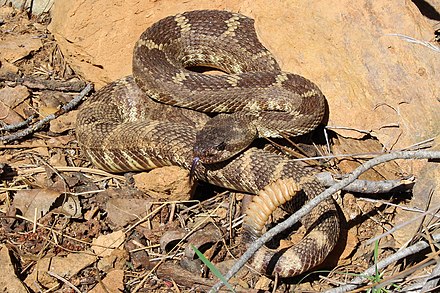
I have to tell you, when you see your first six-foot long rattler, curled up on the front step, you suddenly understand the age-old ancestral fear of wild things. And let’s not fool ourselves—everything out there really is out to get us! Not with malice, of course, but hey, ya gotta eat, right?
Letting the cats out created some difficulties, because cats, as carnivores, will hunt any small thing that moves. So I never did let them stay out past dark, because I knew that once they had fixated on some mouse or rabbit, I’d never be able to get them to come back indoors, which would, in turn, make them easy pickings for the owls and coyotes.
One summer day, I was working on a stained glass project at my desk. The door was open and the cats were enjoying the morning sunshine. About eleven o’clock, a brief picture came into my mind—Tubs facing a big rattlesnake. As I say, brief—the mental picture lasted for all of one second, so I continued working. I kept the television’s volume fairly high most of the time, so, a few hours later, when a sound like shotgun pellets in a dried gourd drowned out the noise from the TV, I was startled. After turning the set off, I looked out the window for the source of this racket: there was Tubs, two feet from a huge rattler, just as the scene had appeared in my mind a few hours earlier. I froze. If Tubs moved suddenly, she’d be struck in the face, and would very likely die from the bite. Fortunately, after a minute, she slowly and cautiously backed away from the snake, which slithered off into the brush.
But I didn’t let it go at that. I knew the snake had made its nest near the house, so there was potential of a repeat performance. I went out, found the snake’s hiding place, and dispatched it.
There was at least one other time that I chose to kill a snake—it had claimed my door- step as its favorite spot for an afternoon sunbath, where it naturally got into a confrontation with another of the cats. Then there were the unnerving occasions when baby rattlers found their way into the house, curling up under the refrigerator or the bookcase—but those I had captured and transported a couple of miles away.
Later, I was nagged by a persistent sense of guilt about killing something whose home I had invaded. After all, I’m the one that’s capable of making the decision to locate to an area that is not paved over and tamed. Living remotely has the advantages of peace and silence, as well as a freedom from the sometimes iron grip of neighborhood obeisance, but “civilized” man, or woman, is unaccustomed to the often life-threatening whims of nature. This was the animal’s home first, and I had no right to punish him because I chose to put myself in the middle of an ecosystem in which I have no natural part to play.
So my eventual solution was to stop letting the cats go out all together. I built them big fenced catteries, as I’d done at other locations. After all, the domestic cat is not a native of North America; its ancestors are originally from North Africa. It doesn’t belong here.
I also made a promise to Big Snake in the Sky that I would never again intentionally kill one of His (or Her) children. Then, as a symbolic gesture, I put a framed painting of snakes on my wall. Since then, everybody inside and out has been happy.

© 2025 Laura J Merrill.

Standard
salamanders, Uncategorized

News from The Treetalker

Today, for your holiday reading, four articles about salamanders, all from the New York Times. I found they have a number of articles about these sometimes exotic creatures, going back a few years, although these were all published in 2018.

“A Salamander of Legend Emerges From Southern Swamps,”
by Asher Elbein, Dec. 14, 2018

“It’s eel-shaped and leopard-spotted, and it has no hind-limbs. It grows to two feet long. And yet until recently, hardly anyone had ever seen it.

A team of researchers has discovered of new species of salamander in the pine forests of northern Florida and southern Alabama. The so-called reticulated siren is the largest vertebrate found in the United States in decades, and the first new member of its family since 1944.”

This is a link to the entire, fascinating article.

18SCI-SALAMANDER1-jumbo-v2

Photo: David Steen

“Vanishing in the Wild, These Salamanders Found Refuge in a Convent,”
by Geoffrey Giller, July 30, 2018

“The Basílica de Nuestra Señora de la Salud, built in the 1500s with whitewashed walls and red stone columns, hosts a thriving colony of endangered salamanders. Scientists call them Ambystoma dumerilii, but the nuns in Pátzcuaro, Mexico call them achoques.

The achoques live their entire lives underwater and keep the external gills that most salamanders have only as aquatic larvae.

Carefully tended by the nuns, about 300 achoques live in glass aquaria and white enamel bathtubs lining the walls of a long hallway and two adjoining rooms in the convent. The nuns support themselves partly by selling a cough syrup called jarabe made from the salamanders’ skin.

They are found nowhere but Lake Pátzcuaro, and outside the convent their numbers are falling fast. This colony may be critical to the salamanders’ prospects in the wild.”

A link to the article is here.

31SCI-SALAMANDERS10-jumbo

“China’s Giant Salamanders Pose a Conservation Conundrum,”
by Rachel Nuwer, June 4, 2018

“The Chinese giant salamander, the world’s largest amphibian and a critically endangered species, has quietly slipped toward extinction in nature. Following an exhaustive, years long search, researchers recently reported that they were unable to find any wild-born individuals.

Millions of giant salamanders live on farms scattered throughout China, where the animals are bred for their meat. But another study by Dr. Turvey and his colleagues shows that reintroducing farmed animals is not a simple solution for saving the species in the wild.

In the wild, Chinese giant salamanders were not just one species but at least five, and perhaps as many as eight. On farms, they are being muddled into a single hybridized population adapted to no particular environment.

“The farms are driving the extinction of most of the species by homogenizing them,” said Robert Murphy, a co-author and senior curator of herpetology at the Royal Ontario Museum. “We’re losing genetic diversity and adaptations that have been evolving for millions of years.”

Many have been released into the wild, in the hope of maintaining the species, but the genetic mixup has created an issue of “pure” wild species.

Here is a link to the article.  www.nytimes.com/2018/06/04/science/giant-salamanders-china.html?action=click&module=RelatedLinks&pgtype=Article

merlin_137526453_cee74480-71fd-4a25-a98f-81f12211abdd-jumbo

photo credits: Goh Chai Hin/Agence France-Presse — Getty Images

merlin_138480822_9f0105cf-277b-4877-9888-c2c7e4f9ba71-jumbo

“The Smiling Axolotl Hides a Secret: A Giant Genome,”
by Nicholas Bakalar, Feb. 1, 2018

“Scientists have decoded the genome of the axolotl, the Mexican amphibian with a Mona Lisa smile. It has 32 billion base pairs, which makes it ten times the size of the human genome, and the largest genome ever sequenced.

The axolotl, endangered in the wild, has been bred in laboratories and studied for more than 150 years. It has the remarkable capacity to regrow amputated limbs complete with bones, muscles and nerves; to heal wounds without producing scar tissue; and even to regenerate damaged internal organs.

This salamander can heal a crushed spinal cord and have it function just like it did before it was damaged. This ability, which exists to such an extent in no other animal, makes its genes of considerable interest.

This is the first salamander genome ever sequenced. The reason it took so long is that it has so many repetitive parts. The study’s author believes that it will open up a wealth of opportunities in studying how organisms regenerate.”

Here is the link.  www.nytimes.com/2018/02/01/science/axolotl-genes-limbs.html?action=click&module=RelatedLinkspgtype=Article

06SCI-NUMBER-jumbo

photo credit: Research Institute of Molecular Pathology

Spotlight on:

Harbor seal    
Although Harbor seals have the greatest geographical range of all seals, encompassing both Pacific and Atlantic Oceans in the Northern Hemisphere, they stay in the coastal areas, rarely going out into the ocean further than ten miles.
They hunt alone, but are sociable when they “haul out” to rest or breed on places that are protected, which can be a beach, a rocky shore, or an iceberg.
Before a seal pup is born, it is covered with a white wooly coat. At birth, it weighs about twenty-five pounds and can swim and dive within four hours. The mother’s milk is 40% fat, so the pup doubles its weight the first month, after which time it is left to learn to hunt and fend for itself.
Seals are distantly related to dogs and bears. They have upper and lower arms and legs that are concealed, and only their hands and feet extend outside the casing of the skin. The hands and feet are known as “flippers,” and are flat and elongated, each having five digits.
They typically dive for about three minutes at a time, but can stay underwater for a half an hour and dive as deep as 600 feet. To do this, they breathe out before diving, using oxygen already in their bodies and slowing their heartbeat from about one hundred beats per minute to ten. In one breath a seal exchanges 90% of the air in its lungs, while we can only change 20%.
Both the United Kingdom and the United States prohibit the killing of seals, although there can be a high mortality rate for pups in some countries, as they can get caught in bottom trawl nets. From Volume 3 of Secret Voices: Crabapple Companions

5

Secret Voices from the Forest – Volume Three: The East is available on Amazon.

Vol. 3 - The East copy

Standard
cutting pollution, Environment, environmental agencies, Green Movement, Renewable Energy, Solar energy, solar power, Uncategorized, water purification, Weather, Wildlife

News from The Treetalker

Large wind and solar farms in the Sahara would increase heat, rain, vegetation

September 6, 2018

Wind and solar farms are known to have local effects on heat, humidity and other factors that may be beneficial — or detrimental — to the regions in which they are situated. A new climate-modeling study finds that a massive wind and solar installation in the Sahara Desert and neighboring Sahel would increase local temperature, precipitation and vegetation. Overall, the researchers report, the effects would likely benefit the region.

read the article here.

180906141611_1_900x600

Map by Eviatar Bach

GOING THE DISTANCE  Painted ladies travel 12,000 km each year, farther than any known butterfly migration

By Leah Rosenbaum, June 20, 2018

Though found across the world, the orange-and-brown beauties that live in Southern Europe migrate into Africa each fall, crossing the Sahara on their journey; analysis of butterfly wings suggests that the butterflies head back to Europe in the spring. The round-trip is about 2,000 more than successive generations of monarchs are known to travel in a year. Some tenacious individuals even make the return trip in a single lifetime.

Read the article here.

061818_LR_butterfly-est_feat

A Leader in the War on Poverty Opens a New Front: Pollution
By Kendra Pierre-Louis, Aug. 24, 2018

The Rev. Dr. William J. Barber II is resurrecting the Poor People’s Campaign, a movement started by Martin Luther King Jr. He sees the climate and environment as issues on par with poverty and racism.

He and Al Gore are bringing attention to the problem of coal ash, its pollution of local drinking water and the health of citizens and workers in the area.

Read the article here.

00cli-ecojustice-barber2-jumbo-v4

Standard
endangered species, energy efficiency, Environment, environmental agencies, Excerpts, green building materials, Green Movement, habitat restoration, invasive species, Nature, plants, Renewable Energy, Solar energy, solar power, Uncategorized, Wildlife

News from The Treetalker

July 20, 2018 – In her blog for Scientific American, Jennifer M. Archambault wrote about Using Herbicides to Save Endangered Snails.

The habitat of the rare, tiny Panhandle pebbles snail, which consumes algae and other microorganisms and is integral to maintaining the ecological balance in river systems, is threatened by an invasive aquatic plant called hydrilla. Introduced through the aquarium trade in the 1950s into the ponds and canals of Florida, it has worked its way into many southern states and is on the Federal Noxious Weeds list. Humans aid in its spread, as it can easily propigate from small fragments on boat motors or fishing equipment. After much field study and testing, it was found in a pilot study in the Eno River in North Carolina that, with applications of a herbicide, the hydrilla is dramatically thinning, and the snails’ population is growing. A great deal of work is left to do to control the hydrilla in the greater Southern water system, but the data gives hope. Read Jennifer’s blog post here.

From ScienceDaily, July 5, 2018. Bacteria-powered solar cell converts light to energy, even under overcast skies!

U of BC researchers have found a cheap, sustainable way to build a solar cell using bacteria that convert light to energy. Their cell generated a current stronger than any previously recorded from such a device, and worked as efficiently in dim light as in bright light. This innovation could be a step toward wider adoption of solar power in places like British Columbia and parts of northern Europe where overcast skies are common. This is great news, particularly since it’s from Canada, where the government hopefully cares about its environment more than the current administration in the U.S.

“We recorded the highest current density for a biogenic solar cell. These hybrid materials that we are developing can be manufactured economically and sustainably, and, with sufficient optimization, could perform at comparable efficiencies as conventional solar cells.” Read the article here.

Another article from ScienceDaily, June 18, 2018

Cementless fly ash binder makes concrete ‘green’
Engineers use byproduct from coal-fired power plants to replace Portland cement. It is made primarily of fly ash, a byproduct of coal-fired power plants. If you noticed an article in the NY Times this week that reported the EPA is easing standards on the disposal of toxic coal ash, this development could provide some way of cleaning up some of the messes created by these plants. Read more about this new composite, environmentally friendly material here.

Another, related article about this sustainable alternative to traditional concrete using coal fly ash is here. This article mentions that the production method doesn’t require heating, which is one of the other polluting aspects of concrete manufacture. The cement less binder also aids groundwater and mitigates flooding, because water can pass through it, unlike cement. Read this article here.

Also, Focus On the Anhinga.

This bird quickly spears a fish with its sharp bill, then flips it into the air and swallows it head first. Sometimes the Anhinga spears the fish so hard it has to return to shore to get the fish off its bill by banging the fish against a rock.
Also known as snakebird, the Anhinga sometimes swims slowly underwater stalking fish around submerged vegetation, but when hunting at the surface, it stretches its head and neck flat out on the surface of the water, above its submerged body. With head and neck stretched out, it has the appearance of a snake is gliding through the water.
The Anhinga’s feathers are not waterproofed with oils, and can get waterlogged, but this helps it stay submerged for long periods of time. Afterwards, it will perch for long periods with its wings spread to dry them. If it tries to fly with wet wings, it has difficultly getting airborne, so it has to take off by flapping energetically and running on the surface of the water.
Once in the air, it is a graceful flier and can go long distances without flapping its wings, using thermals for soaring, and can achieve altitudes of several thousand feet.


Standard