Uncategorized

Tubs and the Snake

When I first moved to New Mexico from Missouri in 1997, I brought along my cats— all seven of them. Four black ones: Peeps, Tubs, Ralph, and Fuzzy, a little white butterball named Fats, a one-eyed grey lady called Mags, and Rosebud, a hardy old tortie, who lived to be twenty-four, probably because of her perpetually crabby attitude.
For their own safety, in urban areas, I had always kept them indoors. So when I moved into my partially finished house on the mesa outside Taos, I thought it would be nice for them to get to roam around a bit, and I began letting them go outdoors for part of the day. That only lasted for a year or two, as interaction with nature became an issue.
My home is literally plunked down in the middle of nowhere, many miles from any town, an off-grid straw-bale house that took me ten years of little-bit-by-little-bit construction to finish, most of it with my own hands.
A few other people live nearby, although none any closer than a half mile, so the local wildlife is as much a part of the neighborhood as humans. There are pronghorn antelope, the occasional elk, the ubiquitous coyote, once a rumored black bear, and rodents by the doubtless millions—of nearly endless variety, including both jackrabbits and cottontail bunnies. Then there are the birds: ravens, bluebirds and mourning doves, flycatchers, quail and three kinds of hummingbirds, owls that you hear but almost never see, finches and sparrows, and a flashy yellow and orange something I saw pass through a couple of times. There are also tarantulas, and to go along with them, tarantula hawks—particularly large, ferocious, orange-winged wasps that lay their eggs inside tarantulas’ live bodies. Eewww.
Then there are the rattlesnakes.
I grew up in the country, but I must have been pretty sheltered, because I don’t think I ever saw anything more intimidating than the black snake that was permitted permanent residence in the oat bin of the horse barn, there to deter mice and rats.
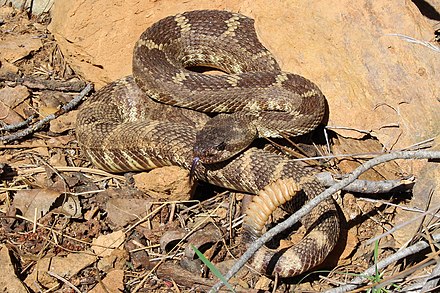
I have to tell you, when you see your first six-foot long rattler, curled up on the front step, you suddenly understand the age-old ancestral fear of wild things. And let’s not fool ourselves—everything out there really is out to get us! Not with malice, of course, but hey, ya gotta eat, right?
Letting the cats out created some difficulties, because cats, as carnivores, will hunt any small thing that moves. So I never did let them stay out past dark, because I knew that once they had fixated on some mouse or rabbit, I’d never be able to get them to come back indoors, which would, in turn, make them easy pickings for the owls and coyotes.
One summer day, I was working on a stained glass project at my desk. The door was open and the cats were enjoying the morning sunshine. About eleven o’clock, a brief picture came into my mind—Tubs facing a big rattlesnake. As I say, brief—the mental picture lasted for all of one second, so I continued working. I kept the television’s volume fairly high most of the time, so, a few hours later, when a sound like shotgun pellets in a dried gourd drowned out the noise from the TV, I was startled. After turning the set off, I looked out the window for the source of this racket: there was Tubs, two feet from a huge rattler, just as the scene had appeared in my mind a few hours earlier. I froze. If Tubs moved suddenly, she’d be struck in the face, and would very likely die from the bite. Fortunately, after a minute, she slowly and cautiously backed away from the snake, which slithered off into the brush.
But I didn’t let it go at that. I knew the snake had made its nest near the house, so there was potential of a repeat performance. I went out, found the snake’s hiding place, and dispatched it.
There was at least one other time that I chose to kill a snake—it had claimed my door- step as its favorite spot for an afternoon sunbath, where it naturally got into a confrontation with another of the cats. Then there were the unnerving occasions when baby rattlers found their way into the house, curling up under the refrigerator or the bookcase—but those I had captured and transported a couple of miles away.
Later, I was nagged by a persistent sense of guilt about killing something whose home I had invaded. After all, I’m the one that’s capable of making the decision to locate to an area that is not paved over and tamed. Living remotely has the advantages of peace and silence, as well as a freedom from the sometimes iron grip of neighborhood obeisance, but “civilized” man, or woman, is unaccustomed to the often life-threatening whims of nature. This was the animal’s home first, and I had no right to punish him because I chose to put myself in the middle of an ecosystem in which I have no natural part to play.
So my eventual solution was to stop letting the cats go out all together. I built them big fenced catteries, as I’d done at other locations. After all, the domestic cat is not a native of North America; its ancestors are originally from North Africa. It doesn’t belong here.
I also made a promise to Big Snake in the Sky that I would never again intentionally kill one of His (or Her) children. Then, as a symbolic gesture, I put a framed painting of snakes on my wall. Since then, everybody inside and out has been happy.

© 2025 Laura J Merrill.
Standard
Empathic readings, Environment, forests, Nature, Spiritual Growth, trees, Trees as Guides

We Are the Leaders We’ve Been Waiting For

A call to grassroots action and shared responsibility, empowering everyday citizens to build a just, sustainable future without relying solely on traditional leaders.

Please watch ON youTube. Like and Subscribe. Thanks so much for watching! 💚

Standard
Environment, forests, Nature, trees, Trees as Guides

The Sacred Tree

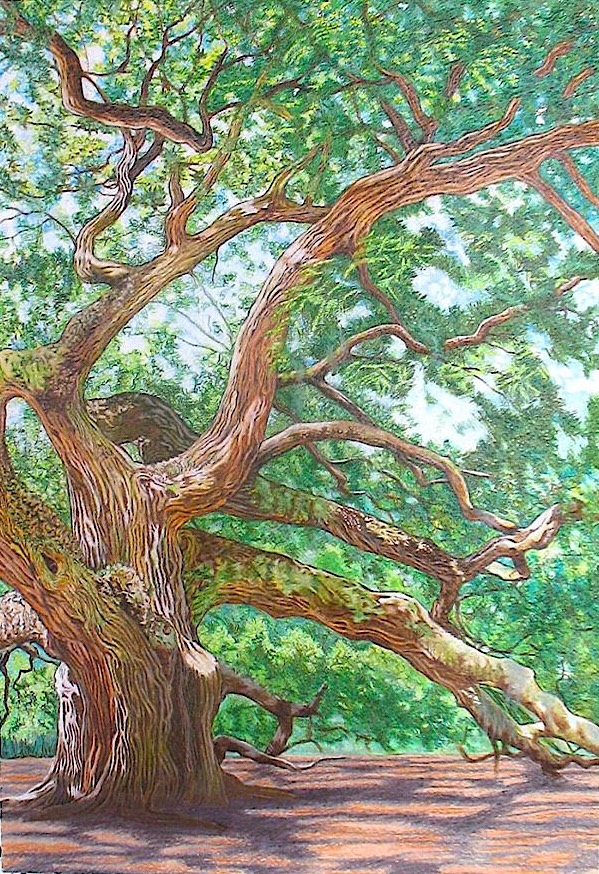
There was a belief that was common to both the tribes of the Celts and of the American Indians. The details are different, but the idea was similar—that a Sacred, colossal tree united the realms of the Earth. The roots were planted in the physical; then, life evolved on its way up the trunk, culminating in the spiritual, which resided in the branches.

The top of the tree was an over-world, where the Sky People dwelt. They were, variously, the star beings seen in the constellations, the godlike progenitors of human kind, or spirit forms who created and then dropped or threw down The People.

Animals seemed to exist already, and could talk and reason and bargain with the Sky People. Sometimes, a mischievous animal would bring a gift—fire or the wheel, or knowledge of agriculture—which would help humans survive and thrive. Because the Sky People were jealous of their exclusive domain, they would become angry with the offending animal, who would be punished by being marked with some physical characteristic—distinctive coloring, for instance—because of this intervention. The Magpie, Coyote, Rabbit, Spider and Raccoon are examples of this.

There was a middle realm in which humans lived, the physical world of day and work. What happened there was caused by, or a reflection of, the events and conditions of the other two worlds.

Last, or rather first, there was a lower region of sleep and dreams and ancestors. This place was seen as the source of life, and the place where all life returned when physical existence was over, to be reabsorbed by Death. The roots of the tree were in the lower region, recognizing that much of the motivation in our everyday lives and thought was unknowable in the light of day, but more powerful and basic than the wakeful mind.

The cultures holding these traditional beliefs lived in or near the great primeval forests, which were thousands of years old when humans first became unified into cultural groups, and the trees would have been seen as not only alive, but as conscious and aware.

In Europe, and the greater part of North America, these mighty forests blanketed thousands of square miles, only broken up by bodies of water, the highest mountains, or regions of steppe. Many of these old trees had massive trunks, or lifted so high into the air that their tops could not be seen from the ground, so it was a completely plausible idea that trees could touch the heavens. There were no tall buildings, and no air travel, and the largest of the great trees would not have been cut down without fear of terrible retribution from the spirit of the land.

The reverent beliefs of those times appear to be long past, and we, as a species, seem to inhale the forests, describing them as “resources;” buying and selling, in cavalier fashion, what took decades, perhaps hundreds, even thousands of years to become part of Nature’s magnificent design.

I’ve given up believing that angry Gods, Goddesses or invisible spirits would avenge Mother Earth for our abuses of the forests, but I do believe that the changes in planetary temperatures, beginning at the dawn of the Industrial Revolution, have reached a point in which climatic backlash is happening in front of our eyes. If we continue much longer to ignore or deny the obvious, the lands retribution for the demise of the great forests will be closer than we think.

© 2025 Laura J Merrill

Standard
endangered species, Environment, Nature

The Importance of Grass

In 1887, the western portion of the Great Plains was described as “an arid and repulsive desert . . . a region of desolation and silence . . . [with] common characteristics of barrenness, inhospitality, and misery,” in A Study in Scarlet, Arthur Conan Doyle’s first Sherlock Holmes adventure. Peoples of the British Isles, and points east had been, for thousands of years, committed to removing as much of “wild” nature as they could. Great cities, housing millions of people, were already common throughout “the Old World,” so to even contemplate migrating to an area where the only inhabitants were tribes of American Indians, who were never excessive in number, and a few rough and hardy trappers, miners and pioneers, was nearly inconceivable. 

Having lived in Utah for several years, I can see why the British, and other Europeans, would consider a place so different from their homelands as inhospitable. However, Doyle’s description was not specifically about Utah, and included a large section of the Short-grass Prairie. 

“Lush” is in the eye of the beholder. Sub-surface life on the plains is more extensive than what is above ground; indeed it has been referred to as “the poor person’s tropical rainforest,” because of the abundant and varied forms of life contained per cubic yard. 

The majority of us may not be particularly into the world of creepy-crawlies, and probably figure, “Oh, what’s the difference if I kill all these little things every time I take a step because there’s so many of them, and I can’t see them anyway.” Nevertheless, it’s worth remembering that in the greater scheme of things, humans are comparatively small, and can be wiped out just as easily. 

How do we know there isn’t a being so immense, compared to us, that we’re unable to take in its entire form all at once, and who, should it take a “step,” would wipe out millions of us at a crack? And while that idea takes us to a “what if?” place more appropriate to science fiction, certain viruses have the capacity to do the job very well, as we have recently come to realize.

While we tend to loathe and fear these microscopic creatures, they, much more than we, hold the planet together—literally. They are what allow plants and animals to absorb nutrients. Without them, “higher” life forms, which have evolved to make use of their abilities, would not survive, and that includes us. Without all those microbes, bacteria, yeasts, and others, Earth would still be a big rock with a molten core, slowly cooling.

But the subject was grass. And the evolution of grasses, it appears to me, accounts for the great explosion of current life forms. Countless animals, of all sizes, eat them, and are eaten in turn, returning in death to the soil and, as a matter of fact, eventually as soil. So the little, humble things such as algae, bacteria, viruses, fungi, ants, bees, birds, and yes, grass, are important—actually, vital. Without any of them, life would all just fade away. 

© Laura J Merrill 2014

Standard